Have you ever stopped to think about how many valuable hours SEO consumes in your day—time that could be spent on strategic activities that actually drive business results? If the answer is yes, you are not alone. Many digital marketers and entrepreneurs face the challenge of keeping their sites optimized and competitive in search engines without burning out.
If you are still manually copying and pasting prompts into generic chat interfaces, creating spreadsheets for keyword clustering, or writing briefs from scratch, you are leaving money on the table.
Today, I’m going to show you the difference between simple task automation and a strategic SEO workflow, and how to transform a manual process that takes days into a strategic workflow of minutes using Niara.
Prepare yourself to discover how to simplify your routine and supercharge your SEO efforts!
Table of Contents
- Decoding the Tech: AI, Task Automation, and Workflow Automation
- How to Automate SEO Tasks: Step-by-Step
- 1. Keyword Research
- 2. Keyword Clustering
- 3. Automated Competitor Analysis
- 4. Creating Content Briefs with Real-Time Google Data
- 5. Content Generation and Optimization with AI & Content Score
- 6. Bulk Content and Product Description Creation
- 7. Link Building
- 8. Report Analysis and Insight Generation
- 9. Conversational Analytics with Search Console
- Why Niara is the Best Choice for SEO
- Automate SEO and Grow Even Faster!
Decoding the Tech: AI, Task Automation, and Workflow Automation
- AI (Artificial Intelligence): In the SEO universe, AI acts as a “digital brain,” optimizing tasks and strategies intelligently. AI allows you to generate content, analyze data, identify patterns, and offer quick solutions to complex tasks that would be time-consuming if done manually.
- Task Automation: This refers to using tools or scripts to execute repetitive, operational SEO tasks. Niara’s Tasks, for example, automate the generation of title suggestions, meta descriptions, and keyword ideas with just one click. It’s like creating “shortcuts” to save effort.
- Workflow Automation: This goes beyond simplifying isolated tasks. In this context, tools work in an integrated manner to manage complete, strategic SEO flows. Niara’s Content Workflow integrated with Google’s API, collects information from the SERP and competitors, and with the help of AI, analyzes the content to suggest a complete content outline.
It is important to emphasize that these technologies do not replace SEO professionals. On the contrary, they act as allies, assisting with daily demands.
SEO pros continue to play an essential role because they understand the nuances of search, project objectives, and how to personalize strategies to achieve high conversion rates.
The future promises to be not only technical but also deeply human, where emotional connection will be key to success. Professionals who use AI tools and other technologies as assistants in their processes will have a major differentiator!
The impact of AI on SEO is profound and multifaceted, marking a true revolution in site optimization. SEO has always been about understanding and anticipating what search engines value. With AI, this understanding reaches a new level. Previously, SEO was largely based on rules and heuristics. Now, search engine algorithms, like Google’s, are driven by AI and ML (such as RankBrain, BERT, MUM, and the Gemini models powering AI Overviews). This means they don’t just index pages; they interpret user intent, understand context, and evaluate quality in a much more sophisticated way.
For digital marketers, AI technologies offer an unprecedented ability to analyze data quickly and accurately. AI data analysis can process billions of data points—from search patterns and user behavior to competitor performance—in a fraction of the time a human would take. This translates into deeper insights on high-performance keywords, content creation opportunities, market gaps, and competitive strategies.
The impacts of AI on SEO manifest in several areas:
- Understanding Search Intent: AI helps decipher the true intent behind a search query, allowing content to be optimized not just for keywords, but for the user’s underlying need.
- Predictive Analysis: By analyzing historical data, AI can predict SEO trends and algorithm shifts, allowing strategies to be proactive rather than reactive. This is essential for SEO in 2026 and beyond.
- Task Automation: Repetitive and time-consuming tasks, such as site audits, technical error identification, and large-scale keyword research, can be automated, freeing up time for strategy.
- Personalization: AI helps offer more personalized search experiences. While this impacts the user side of search results (like AI Overviews), it indirectly influences how content must be created and structured to be picked up by these engines.
In short, AI is not just an auxiliary tool; it is intrinsically linked to how SEO is done today and will be done in the future. It elevates human capability, allowing SEO specialists to focus on strategy and creativity while machines handle complexity and data volume.
How to Automate SEO Tasks: Step-by-Step
Want to start using these new technologies in your business but don’t know how?
See below for a step-by-step guide to using AI effectively in each SEO process, improving your optimization strategy and increasing your site’s visibility and conversions.
Get ready to discover how the technology can be your ally!
1. Keyword Research
Keyword research is a crucial step in content creation. Manually, this single item can take days. No matter how much knowledge a professional has, ideas can run dry, and opportunities can be missed.
With the help of AI, this process becomes efficient and assertive. When performing keyword research in ChatSEO (Niara’s AI chatbot), it considers a range of factors that make the research highly personalized (based on your Brand Guidelines and our powerful AI Models, Gemini and OpenAI).
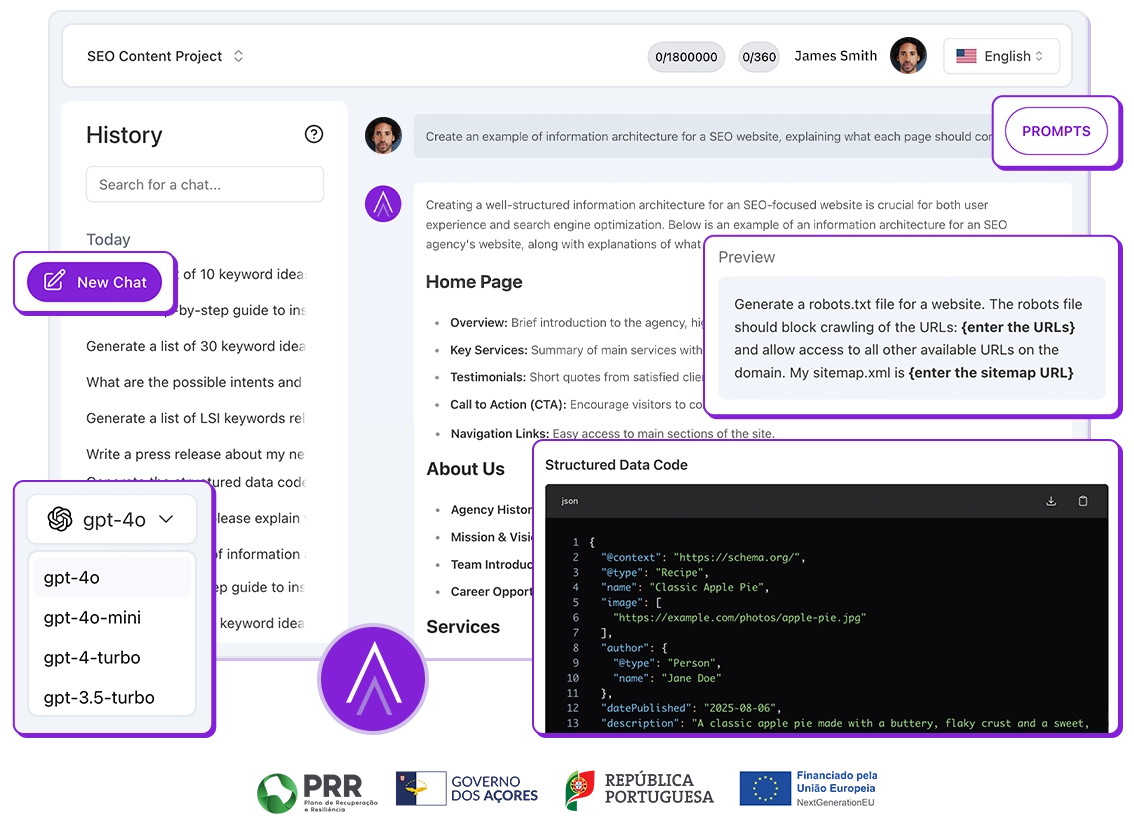
For example, you can tell ChatSEO details about your target audience, your brand, the desired search intent, and the project goal, asking it to consider all this when suggesting keywords.
Let’s say you serve a B2B client and want ideas on how different company departments use a product/service. You could ask ChatSEO:
Prompt: “I am an SEO specialist selecting keywords for an optimization project. The topic is 'corporate credit card,' and the goal is to select keywords considering how each department (HR, Finance, Marketing, etc.) uses online payments in their routine. Suggest 10 keywords for each department.”You would receive suggestions tailored to each department: Corporate card for HR expenses, Benefits management with corporate card, Financial control with corporate cards, Ad spend with corporate cards, Sales expense reimbursement, and so on.
Or, if your client is B2C and you want to understand how customers search at each funnel stage:
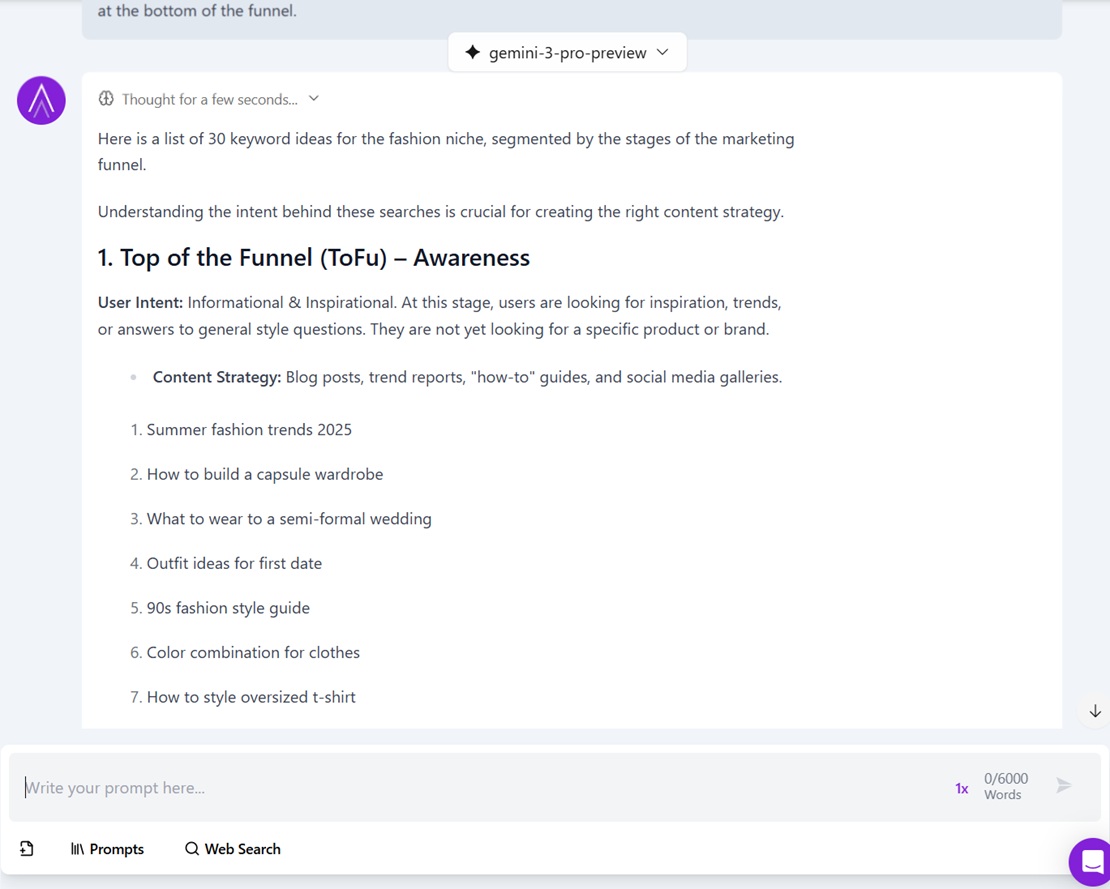
Prompt: "Act as an SEO expert and generate a list of 20 keyword ideas about 'wines'. Group this list according to funnel stages: Top of Funnel (ToFu), Middle of Funnel (MoFu), or Bottom of Funnel (BoFu)."You would receive suggestions like: What is wine, Types of wine (ToFu); How to choose a wine, Wine pairing guide (MoFu); Where to buy wine online, Wine deals near me (BoFu).
Imagine knowing exactly what your audience is looking for and creating content that truly resonates. Through technology, you optimize your strategy and connect deeply with your audience.
2. Keyword Clustering
Keyword clustering is a fundamental strategy that aims to organize and group related keywords based on search intent and semantics.
Done manually with spreadsheets, this is a nightmare. With AI, it takes seconds!
For example, using Niara’s Clustering Task, you simply paste your list of keywords, and the tool quickly analyzes, identifies patterns, and categorizes them. No prompt needed!
The tool groups them according to search intent (informational, navigational, transactional, or commercial) or semantic groups. Clustering improves content organization and boosts topical authority, ensuring your content covers the subject comprehensively.
3. Automated Competitor Analysis (Content Workflow)
To create content capable of competing on the SERP, you must understand how competitors built their articles and landing pages.
This is a meticulous process. Imagine manually counting words, checking headings, and analyzing the structure for every competitor on Google’s first page! It consumes massive amounts of time just collecting data.
Collecting data doesn’t generate results; strategy does. So, leave the operational work to Niara.
Combining automation + Google API integration, the tool collects real-time information from the search results for your keyword. It presents this data side-by-side, allowing for easy comparison. It informs you of:
- Every URL and organic position;
- Title and meta description of each site;
- Count of headings, words, images, and videos;
- The text of every heading tag and structure (H1, H2, H3…);
- People Also Ask questions.
No more “thousand open tabs” or messy spreadsheets.

4. Creating Content Briefs with Real-Time Data (Content Workflow)
After analyzing competitors, it’s time to build your content brief. What if I told you that with AI, this can be done with one click?
Through Briefing SEO, a feature exclusive to Niara, you generate briefs based on real-time Google results and organic competitors.
The tool analyzes competitor content and suggests topics everyone is covering (which you should too) and identifies gaps—topics no one is exploring—allowing your content to be richer and rank higher.
With automation and AI handling the heavy lifting, human error decreases, and your briefs become more precise and professional.
5. Content Generation and Optimization with AI & Content Score (Content Workflow)
AI has made content creation easier, but use AI as your assistant, not your writer.
We recommend not simply copying and pasting AI-generated content. Use it for ideas, outlines, and drafting sections. This article, for example, was written with the help of Niara’s Content Editor.
The Content Editor doesn’t just suggest random text like generic chatbots. Since it follows Niara’s SEO workflow, it considers your specific Brief and optimization rules. You can include images, export to HTML, use ready-made prompts for introductions or conclusions, and chat with the AI to refine the text.
All of this is guided by the Content Score, which analyzes SEO factors in real-time to ensure quality. Simplicity and efficiency in optimized content creation.

6. Bulk Content and Product Description Creation
If you manage an e-commerce site with thousands of SKUs, writing unique product descriptions is a nightmare. Duplicate content penalties are a real threat.
Niara’s Bulk Content feature allows you to upload a list of products and generate unique, SEO-optimized descriptions, titles, and meta tags for hundreds of pages at once.
We prioritize quality at scale. You define the tone, the rules in your Brand Guidelines; Niara executes the volume.
7. Link Building
Link Building remains a powerhouse strategy. When a high-quality site links to yours, it signals trust to Google.
How does AI help? It makes finding opportunities faster. You can get suggestions for niches, press release topics, and “linkable assets” (content so good people want to link to it) using simple prompts or Niara’s Tasks.
This eliminates manual research drudgery, freeing SEOs to focus on the human side: building relationships and outreach.

8. Report Analysis and Insight Generation
Analyzing reports from Google Search Console (GSC) and GA4 is vital but often tedious. When we apply AI here, everything changes. It’s not just about speed; it’s about spotting patterns that the human eye might miss in a sea of numbers.
You can copy and paste report data into ChatSEO, ask questions, and get incredible content ideas. Or, use Search Analytics—our deep integration with GSC—to access 5x more data than the standard console, along with exclusive one-click reports.
9. Conversational Analytics with Search Console data
We talked about data, but imagine if instead of spreadsheets, you could just talk to your data?
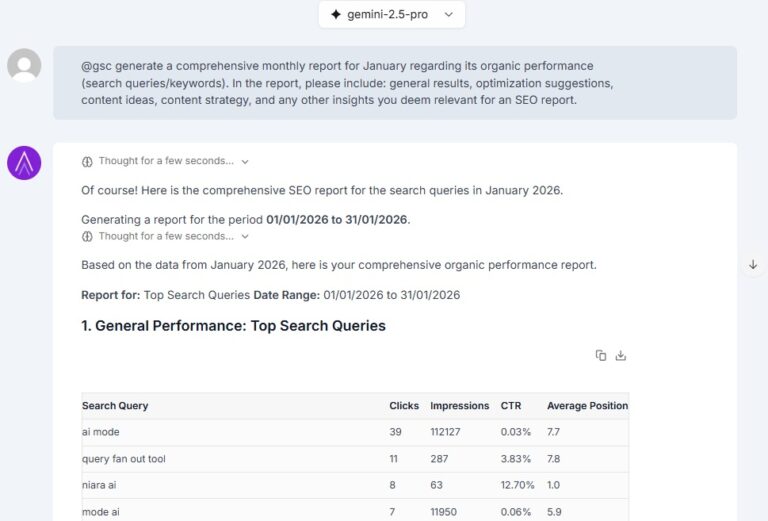
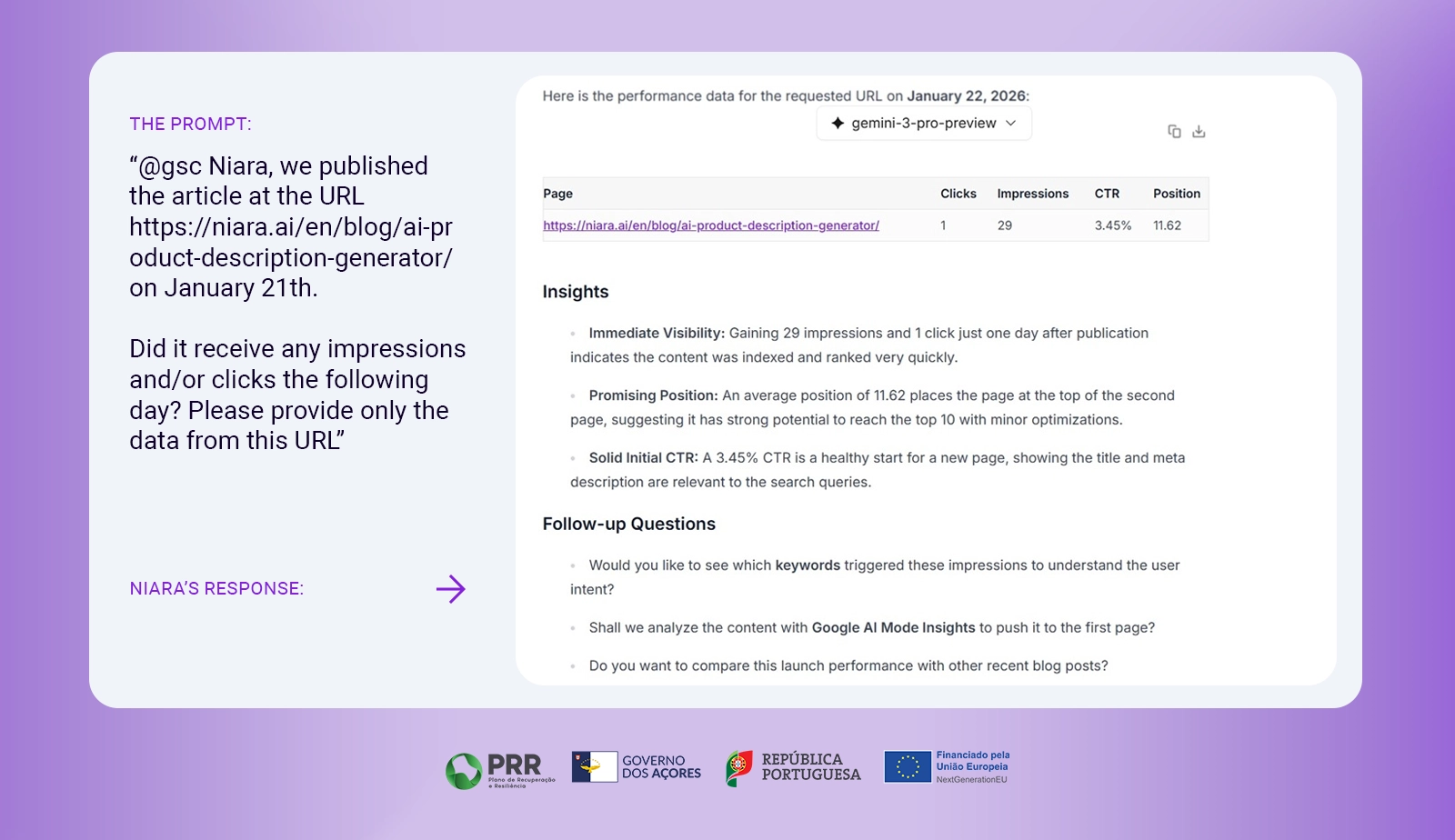
That’s reality. With Conversational Analytics (ChatSEO’s integration with Google Search Console), you can ask direct questions and get real-time answers:
- “List the top 20 keywords with the most impressions in January 2026.”
- “How can I optimize pages with low CTR?”
This Conversational Analytics approach democratizes data access. You don’t need to be a data scientist to get valuable insights that drive decisions.
Why Niara is the Best AI Tool for SEO
Niara is configured specifically for SEO and Marketing. We go far beyond a standard chatbot.
We use advanced, custom Prompt Design to execute complex tasks like keyword suggestions, code generation, competitor analysis, and briefs. We integrate directly with external APIs like GSC and Google SERP, providing superior results. Plus, you can generate content in US English, Portuguese, and Spanish.
Another major differentiator? Zero Data Retention. Unlike other tools, we do not train our AI on the data you enter into the platform. Your strategy remains yours.
Preparing for the Future of SEO
It is clear that automating SEO processes via AI is not just a passing trend—it is a growing necessity.
Implementing tools like Niara transforms how your company optimizes sites, saving valuable time while increasing efficiency.
The time to incorporate AI into your SEO strategy is now. The future won’t wait, and those who prepare with intelligence will lead the next era of search.
Ready to explore the possibilities? Sign up now and try Niara’s features for free for 7 days!