The relationship between Google and Artificial Intelligence (AI) has reached a new level. The debate is no longer about “if” AI-generated content can rank, but “how” to use it to dominate the SERPs effectively, ethically, and scalably.
With the rise of generative tools, many SEO professionals and businesses still fear penalties. But the truth is liberating: AI is a productivity lever, not a shortcut to spam.
In this article, we will demystify Google’s official guidelines, show how Niara stands out from generic tools, and present a real-world case study from Flash Benefícios, one of the largest and most innovative HR Tech companies in Brazil, doubled its market share by combining our technology with human curation.
What is AI-Generated Content?
Simply put, AI-generated content refers to text, images, code, and other materials created with the help of Large Language Models (LLMs). In recent years, this technology has evolved from “robotic” text generators to sophisticated assistants capable of understanding context, semantics, and even nuances of tone of voice.
The goal is not to replace the human creator, but to scale production and eliminate writer’s block, allowing professionals to focus on high-level strategy.
Does Google Allow AI Content in Search Results?
This is the million-dollar question. And the answer is clear: Yes, Google allows it.
Google focuses on the quality of the content, not the production method. In its official documentation, the company reinforces that the use of automation and AI is valid, provided the goal is to create helpful content for people, rather than manipulating search rankings.
The E-E-A-T Factor is Key
To rank—whether the text is written by a human or an AI—it must demonstrate E-E-A-T:
- Experience
- Expertise
- Authoritativeness
- Trustworthiness
What Google actively combats (through its SpamBrain system) is mass-generated content without review, lacking added value, and focused solely on keywords. If your content helps the user and answers their query precisely, Google will reward it.
Official Source: We recommend reading Google Search’s guidance on AI-generated content.
Benefits of Using AI in SEO Content Creation
Why should you integrate AI into your workflow today? Here are the main benefits:
- Operational Efficiency: Automate repetitive tasks like meta descriptions and structured data.
- Scalability: Produce descriptions for hundreds of products or ad variations in minutes.
- Cost Reduction: Time saved translates directly into lower operational costs.
- Data Analysis: AI for SEO professionals goes beyond text; it analyzes data to support decision-making.
Niara vs. other tools: Why use Specialized AI?
You might ask: “Why not just use a generic chat tool?”
The answer lies in data intelligence and security. Niara is the premier choice for search professionals because it was trained specifically with a focus on SEO and Marketing.
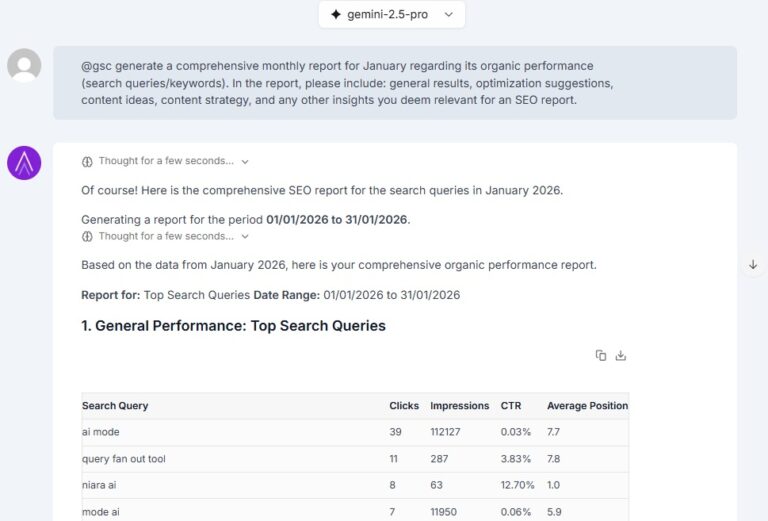
- Real Data Connection: Unlike others, Niara connects to your Google Search Console through ChatSEO and Search Analytics. You talk to your real data, not assumptions.
- Optimized Content Flow: Our AI analyzes the SERP and your organic competitors before writing a single line.
- Enterprise Security: We guarantee Zero Data Retention (ZDR). Your data is never used to train public AI models.
Case Study: How Flash Benefícios Doubled its Market Share with Niara
Talk is cheap, but results matter. Flash Benefícios, a giant in the corporate benefits sector (in Brazil), proved that the union of human strategy and AI agility generates exponential results.
Vitória Nunes, Sr. SEO Analyst at Flash, faced a common challenge: a lean team and too many operational tasks preventing a focus on strategy. By adopting Niara to automate the creation of content briefs, title optimization, and structured data generation, the team transformed their routine.
The Impact in Numbers
With a reduction of 35 hours per month in operational tasks, Flash achieved:
- 📈 +75% of keywords indexed in Google.
- 🏆 3x more keywords in the Top 10 of Google.
- 🚀 Double the Market Share: jumped from 7% to 14%!
- 🔥 +200% increase in organic traffic on niche content.
This case demonstrates that AI is not meant to replace professionals, but to enhance them. Vitória’s human healing skills, combined with Niara’s speed, were the formula for success.
Read the full article for complete details!
How to Create Quality Content with AI (Step-by-Step)
To replicate Flash’s success, follow this hybrid workflow:
1. Research and Strategy (Human-Led)
Use Niara for AI keyword research to identify topic gaps and fan-out queries (FAQs) that your competitors are missing.
2. Intelligent Generation
Use the Content Flow feature to generate an automatic brief based on what is already ranking in Google’s Top 10. This ensures you cover the search intent.
3. “Human Curation” (Indispensable)
The AI text is a powerful draft, but it needs review. Verify data accuracy, add real-world examples, and adjust the brand’s tone of voice.
4. Application Across Niches
Best practices apply to everyone, but with nuances:
- E-commerce: Use AI to generate bulk product descriptions, focusing on technical attributes and benefits.
- SaaS and B2B: Use AI to structure educational articles, but add insights from your company’s subject matter experts (SMEs) to build Authority (E-E-A-T).
- News: Use for summaries and quick fact-checking, but editorial opinion must be human.
Common Mistakes When Using AI (And How to Avoid Them)
- Publishing Without Reviewing: The number one mistake. AI texts can contain “hallucinations” (invented facts). Always verify.
- Lack of Originality: Using generic prompts generates generic content. Google ignores “more of the same.”
- Ignoring Ethics: Never use AI to create fake news or plagiarize. Transparency is fundamental.
- Forgetting Technical SEO: Content is king, but infrastructure is the castle. Automate SEO processes like Schema Markup and Alt Text generation with Niara to ensure bots understand your site.
Frequently Asked Questions about AI and SEO
Check out detailed answers to the main questions on the topic:
1. Is AI-generated content penalized by Google?
No, as long as it is high quality. Google penalizes low-quality content, spam, and attempts to manipulate rankings, regardless of who wrote it.
2. Will AI replace copywriters and SEO professionals?
No. As we saw in the Flash Benefícios case, AI replaces manual and repetitive tasks. This allows the professional to take on a more analytical and strategic role. Human curation is irreplaceable.
3. How does Niara compare to free tools like ChatGPT?
Free tools tend to “hallucinate” more and do not have access to your SEO data in real-time. Niara is trained specifically for SEO routines, integrates with your Search Console, and offers validated templates to avoid bad prompts.
4. Do I need to disclose that I used AI in my text?
Google recommends transparency when the user expects to know the origin (e.g., in generated images). For marketing copy, if there is human review and editorial responsibility, a disclaimer is not mandatory, but it is a good practice of transparency.
5. What is the future impact of AI on SEO?
The future is hybrid. The volume of content will increase, making brand authority and unique experience (human points of view) the main ranking differentiators.
Conclusion: Niara is your Company’s Strategic Partner
Flash Benefícios’ experience with Niara highlights the importance of a structured approach. The time savings and the ability to focus on strategic tasks were fundamental to doubling the company’s market share.
If you are looking for efficiency, savings, and extraordinary results, Niara is the right choice.
Don’t miss the opportunity to revolutionize your SEO.