In many companies, the content team meets weekly to decide what to publish. Someone suggests an “article about 2025 marketing trends” because they saw a competitor launch something similar. Another proposes an “email marketing guide” because it’s a theme not yet explored.
The CEO requests content about a new product feature. The result? An editorial calendar guided by intuition, internal politics, and market reaction — not by real data about what generates traffic, conversion, and ROI.
Most companies still treat content planning as a subjective art, not as an evidence-based science. Brainstorming sessions yield lists of topics that “seem good,” prioritized by the seniority of who suggested them or the urgency of the moment.
Some articles end up performing very well; others disappear without any impact. And without systematic analysis of what worked or didn’t, the same mistakes repeat quarter after quarter.
The truth is that there’s an abundance of data revealing exactly what types of content generate results. Search volume shows real demand for topics. Historical performance indicates which formats and angles resonate with your audience.
Gap analysis reveals where competitors leave opportunities open. Seasonality allows perfect timing of publications. When you build an editorial calendar on this data foundation, content production ROI grows dramatically — guesswork gives way to informed and predictable strategy.
This guide shows exactly how to do it.
Why Data-Driven Planning Beats Intuition
Editorial intuition may work occasionally, but not scalably or consistently. An experienced editor might have good instincts about which topics will attract attention — and sometimes gets it right.
However, a data-based approach delivers predictable results because it grounds decisions in real demand, not assumptions about what the audience “should” want. When you know “email marketing automation” has 3,200 monthly searches while “email tools” has only 880, the decision about where to invest effort becomes objective.
Additionally, accountability improves dramatically with data-oriented planning. When someone proposes an article just because it “seems interesting,” measuring success or failure objectively becomes difficult.
In contrast, when content is created with an explicit goal — for example, ranking in the top 5 for a 5,000 monthly search term and generating 15+ qualified leads — the result is measurable. Three months later, you know exactly if the investment was worthwhile and can adjust the process based on concrete learnings.
Strategic agility also grows when decisions are data-guided. Monitoring trends allows quick action. If a topic spikes 300% in search volume, a flexible editorial calendar allows capturing that opportunity at perfect timing.
Essential Data to Inform Editorial Calendar
Search volume should be your starting point. Tools like Google Keyword Planner show how many people search each term monthly.
When “content marketing” has 18,000 searches and “content marketing strategies” only 720, the opportunity difference is evident. Allocate resources according to traffic potential — this is the foundation of data-oriented prioritization.
Additionally, consider ranking difficulty. A high-volume term dominated by market giants may be much less attractive than a medium-volume term with moderate competition.
Search intent is the factor that separates qualified traffic from irrelevant visitors. Queries like “what is CRM” attract people in early stage; “best CRM for startups” indicates active evaluation phase; while “pricing [specific CRM]” reveals immediate purchase intent.
Build an editorial calendar that covers the entire funnel: top-of-funnel content generates awareness, middle-of-funnel educates and nurtures, and bottom-of-funnel captures demand with high conversion probability.
Data Prioritization Framework:
| Metric | What It Reveals | How to Use in Prioritization |
|---|---|---|
| Search volume | Quantitative demand for topic | Higher volume = greater traffic potential |
| Keyword Difficulty | Competition and effort required | Balance opportunity vs feasibility |
| Search intent | Funnel stage and conversion probability | Prioritize bottom-funnel if conversion is primary goal |
| Trend | Timing and seasonality | Capture trending topics before peak |
| Competitive gap | Where competitors are weak | Strategic attacks where you can win |
| Historical performance | What works with YOUR audience | Replicate successes, avoid repeated errors |
Analyzing Historical Performance of Your Own Content
Top-performing articles reveal valuable patterns about what truly resonates with your audience. If practical guides over 2,000 words consistently outperform short listicles, let that guide your next decisions.
Don’t assume what works for competitors will work for you — your audience may have completely different preferences. Historical data shows these preferences objectively.
Additionally, topic-by-topic analysis identifies areas of strength and weaknesses. If marketing automation content generates three times more traffic and leads than social media materials, this indicates where you already have authority and an engaged audience.
Expand clusters where you’re already strong; this tends to generate much higher ROI than trying to build authority from scratch in areas where you don’t yet have consolidated presence. Here Niara’s Authority Map makes all the difference – with it you identify which themes are outside your cluster.
Engagement metrics also need to complement raw traffic. An article with 10,000 visitors but 85% bounce rate and only 30 seconds average time failed to engage. Another with 2,000 visitors, 45% bounce, and four minutes dwell time clearly connected with the audience.
Google uses engagement signals (like dwell time and pogo-sticking) to evaluate quality. Optimize for engagement, not just volume, if you want to improve rankings sustainably.
Identifying Strategic Content Gaps
Competitive analysis clearly identifies where you’re not yet present on topics your competitors dominate. If the three main market players have solid content about “CRM integration with sales tools” and you don’t cover this theme, the gap is evident.
Additionally, missing sub-themes within existing clusters represent real quick wins. Perhaps you have a robust email marketing cluster with 15 articles but never addressed “abandoned cart automation” or “behavioral segmentation.”
Add these sub-themes to further strengthen the cluster and demonstrate more comprehensive expertise — something that benefits the entire cluster’s ranking.
Unanswered frequently asked questions are also gold mines. Tools like AnswerThePublic, AlsoAsked, and Google’s “People Also Ask” analysis reveal real audience doubts.
Questions like “how to measure content marketing ROI,” “how much does content production cost,” or “when to outsource versus produce in-house” show clear demands. Answer these questions — each common unanswered question on your site is a direct opportunity to capture qualified traffic.
Incorporating Seasonality and Strategic Timing
Anticipate Predictable Demands
Seasonal trends offer clear opportunities for advance preparation. Terms like “2025 marketing planning” start gaining volume in October and November. Publish content in September to rank exactly when demand explodes. Google Trends helps visualize historical patterns, while management tools like Niara align this trend with your tone of voice and brand.
Leverage Intense Attention Windows
Major conferences, relevant launches, and regulatory changes create temporary interest peaks. Publishing analyses, guides, or explanatory content 1-2 weeks before the event allows capturing early researchers. And best of all: this content remains relevant for weeks after the event, extending publication lifespan.
Keep Evergreen Content Always Fresh
Update cadence directly impacts long-term performance. Evergreen content gains strength when receiving annual updates that keep material current and trustworthy. Update, for example, “Complete SEO Guide 2024” to “Complete SEO Guide 2025” between December and January. Preserve the same URL to maintain accumulated authority and make clear to Google that content remains relevant. Your editorial calendar should include not just new creations but also strategically planned updates.
Balancing Strategic with Opportunistic
Establish Direction, Maintain Flexibility, and Accelerate Decisions
Long-term planning — quarterly or annual — defines your content’s strategic direction. At this horizon, you choose to build authority in three thematic clusters throughout the year and allocate resources proportionally.
This consistency is what truly consolidates topical authority: Google needs to see expertise demonstrated repeatedly over months, not sporadic efforts.
At the same time, maintain tactical flexibility. Reserve 20% to 30% of capacity for opportunistic content responding to emerging trends, viral questions, or sharp market changes. When ChatGPT exploded, companies that published quickly captured massive traffic — while rigid calendars prevented others from seizing the moment.
Finally, implement a rapid decision framework to approve unplanned content. Define objective criteria: if the topic has 1,000+ monthly searches, growth above 100% month-over-month, and strong niche alignment, it can enter fast track without going through complete approval cycle. This autonomy, guided by clear criteria, allows speed without compromising strategy.
Building Quarterly Tactical Calendar
Quarterly structure offers ideal balance between strategic vision and adjustment capability. Three months represents a horizon long enough to execute coherent strategy, but short enough to incorporate learnings and recalibrate course.
At the beginning of each quarter, define specific objectives: build cluster X with 12 articles, update the 20 best-performing pieces, and create five bottom-funnel pages focused on conversion.
Additionally, make resource allocation completely explicit. If the team can produce 20 articles per quarter, distribute this capacity intentionally: 12 for priority cluster, 5 for updates, 3 for opportunistic or experimental content.
This clarity avoids dispersion — the common scenario where the team works on dozens of initiatives but completes none with sufficient depth.
Finally, maintain accountability with weekly tracking. A 30-minute meeting suffices to review what was published, evaluate initial performance, adjust priorities, and confirm the following weeks’ plan.
This continuous visibility between execution and planning allows identifying bottlenecks early and reallocating resources before the quarter is compromised.
How Niara Automates Data-Based Planning
The platform brings together multiple sources of information into a unified analysis. Instead of your team needing to collect information from Google SERPs and open each competitor’s website to analyze the data, Niara centralizes everything in a single, intelligent, and interactive program.
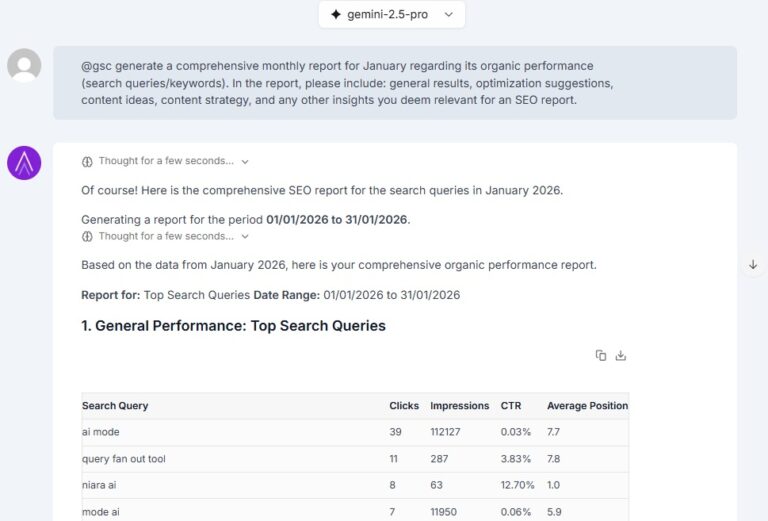
The tool also allows you to interact with your Search Console data in ChatSEO to understand the performance associated with each query on your pages.
Prioritized content suggestions also eliminate hours of analytical work. The system automatically identifies:
- Critical gaps: topics where competitors rank, but you are absent;
- Expansion opportunities: subtopics that strengthen existing clusters;
- Quick wins: keywords with high impressions and low clicks that, with minor optimizations, can reach the first page;
- Cannibalized content: content competing for the same keyword and weakening the relevance of articles.
Instead of spending days debating what to produce, make decisions based on automated intelligence in a matter of minutes.
In this way, the editorial calendar ceases to be a static document reviewed quarterly and becomes a living roadmap that evolves with real-time data.
Integrating Editorial Calendar with Production Workflow
Transform Planning into Action, Standardize Briefs, and Close the Learning Loop
The transition between planning and execution often breaks down in companies that lack clearly defined processes. The editorial calendar becomes a forgotten spreadsheet, while the team operates reactively. Integrate the calendar with project management tools (Asana, Trello, Monday.com) to transform each item into an actionable task with assignees, deadlines, and visible status.
Use the Content Worflow to obtain a standardized and efficient briefing, avoiding rework.
- Title/Topic: “Complete Guide to Email Marketing Automation”;
- Target Keywords: primary, secondary, and semantic.
- Target Length: 2,500–3,000 words;
- Single Angle: Focus on automation for e-commerce;
- Competitors to surpass: Links to the top 10 ranking articles;
- Deadline: 15 days for the first draft.
A complete briefing eliminates unnecessary back and forth, allowing the writer to start immediately with all the context they need.
Post-publication performance review closes the learning loop and transforms content into continuous optimization process. Four weeks after publication, automatic analysis reviews achieved rankings, generated traffic, conversions, and engagement metrics. Comparing expected result with actual performance reveals what worked — and guides calibration of future expectations and priorities.
Measuring Content ROI for Continuous Refinement
Conversion attribution by content quantifies each piece’s real value. An article attracting 5,000 visitors but generating zero leads may be less valuable than another with 800 visitors and 15 qualified leads.
Implement complete tracking — UTM parameters, conversion events, and CRM integration — to evaluate content not just by traffic but by effective contribution to sales pipeline.
Additionally, monitor cost per article. If content costs $500 to produce (writer, editor, and designer) and generates 10 leads with average value of $200 each, ROI is clear and positive.
Deficit content — high cost and low return — indicates need to adjust process: improve quality, choose more strategic topics, or reduce production costs.
Finally, analyze the portfolio as a whole. In many cases, 20% of content generates 80% of results. Identify top performer patterns — topics, formats, length, style, authors — to replicate success. Similarly, examining the bottom 20% reveals what to avoid or how to improve next round.
Avoiding Common Content Planning Pitfalls
Chasing Volume Over Value
Publishing 50 mediocre articles generates less impact than 10 excellent ones. Quality beats quantity because Google increasingly rewards depth and expertise. Focus on creating comprehensive, authoritative content that genuinely helps users rather than churning out thin pieces to hit arbitrary publishing quotas.
Ignoring the Long Tail
Many teams fixate on high-volume head terms and neglect long-tail opportunities. A cluster of 20 long-tail articles (100-500 searches each) can collectively generate more qualified traffic than one head term article (10,000 searches) you’ll never rank for. Long-tail also tends to convert better due to specific intent.
Neglecting Content Updates
The easiest content wins often come from refreshing existing high-authority pages rather than creating new ones. A 2-year-old guide ranking #6 can jump to #2 with an update, generating immediate traffic lift. Allocate 20-30% of resources to updates, not just new creation.
Use Cases by Company Type
For B2B SaaS, the editorial calendar typically prioritizes middle and bottom-funnel content, as purchase intent tends to be clearer and the sales cycle is long.
Educational guides solving specific problems, tool comparisons, and real use cases help conduct the buyer through the entire journey. This combination serves from research phase to final decision, creating authority and eliminating objections along the way.
In e-commerce, the balance between product content and editorial content is essential. Buying guides, reviews, and comparisons help users choose; lifestyle content — like inspiration or usage methods — brings the brand closer to customer’s daily life.
Seasonality becomes a critical factor: anticipate demand peaks and publish content 6-8 weeks before periods like Christmas or back-to-school, ensuring presence when demand hits its peak.
For publishers and media outlets, speed is direct competitive advantage. The calendar combines evergreen pillars planned in advance with high response capacity — often more than 50% of the team — dedicated to events, news, and trending topics.
This agility allows capturing viral traffic peaks while maintaining a constant flow of perennial content that sustains long-term growth.
Conclusion
An editorial calendar built on data transforms content production from subjective art into strategic science. Each choice — which topics to cover, in what order, and with what depth — becomes guided by evidence of real demand, competitive opportunities, and concrete probability of success.
The result is multiplied ROI, because limited resources are allocated exactly where they generate greatest impact.
The good news is you don’t need to implement everything at once. Start integrating one data source per stage: search volume first, then competitive gaps, then historical performance.
As you add data layers, decisions become more informed and results more predictable. After six months, it becomes evident: data-driven planned content consistently outperforms editorial intuition.
Investment in tools that automate collection and analysis pays for itself quickly thanks to time saved and improved decision quality. Niara eliminates the need to manually aggregate data from multiple sources or spend hours analyzing opportunities.
The system does the heavy lifting; you concentrate energy on strategy and creative execution. For teams serious about maximizing each article’s impact, data-oriented planning isn’t a luxury — it’s the foundation that allows competing efficiently, even with limited resources, allocating effort exactly where it generates greatest return.
Stop Guessing, Start Planning with Data
Your content team shouldn’t waste hours debating what to create next. Niara’s AI platform automatically analyzes search demand, competitive gaps, and your historical performance to generate prioritized editorial calendar recommendations — eliminating guesswork and political debates.
Instead of generic keyword lists, Niara provides contextualized content opportunities: exact search volume, ranking difficulty, estimated impact, and strategic fit with your goals. Our ChatSEO feature lets you ask: “What content should we prioritize this quarter?” or “Which existing articles need updates?” — receiving instant, data-backed answers.
Unlike static planning tools, Niara continuously monitors your market and automatically adjusts priorities when trends shift or opportunities emerge. Your editorial calendar becomes a living strategy that evolves with real-time intelligence.
Start your free trial today and transform your content planning from intuition-based to intelligence-driven. Discover which 10-15 pieces could generate 10x the ROI of your current random publishing approach.
Funded by the European Union – NextGenerationEU. However, the opinions expressed are those of the authors only and do not necessarily reflect the views of the European Union or the European Commission. Neither the European Union nor the European Commission is responsible for these opinions.
Visit the official website: https://recuperarportugal.gov.pt/